Why Your Pet Resort Marketing Isn’t Working (Hint: It’s Not the Ads)
If you’ve ever looked at your marketing reports and thought, “We’re spending money… so why aren’t we getting more bookings?”—you’re not alone.
And here’s the truth most agencies won’t tell you:
It’s probably not your ads.
Let’s break down what’s actually going wrong.
Problem #1: You Don’t Have a Funnel—You Have Fragments
Most pet resorts have a combination of marketing efforts running:
- Google Ads & Meta Ads managed by an agency
- Social media content posted internally
- Email campaigns sent periodically
- Referral and word-of-mouth marketing
The challenge isn’t that any one of these activities is ineffective. The challenge is that they’re often being managed separately, without a unified strategy connecting them.
Instead of a funnel, you have disconnected efforts that rely on luck instead of design.
What should be happening instead:
Your marketing should guide pet parents through a journey:
- Awareness: “I need a place for my dog.”
- Consideration: “Can I trust this place?”
- Conversion: “I’m booking here.”
This is where many pet resort owners benefit from working with a specialized marketing partner. Instead of treating marketing as a collection of individual tactics, a strong agency helps connect every touchpoint into a complete customer journey.
Problem #2: Your Website Isn’t Converting
You could be driving tons of traffic… and still losing bookings.
Common issues we see:
- No clear call-to-action (“Book Now” is buried or unclear)
- Lack of pricing transparency (creates hesitation)
- Weak trust signals (reviews, certifications, photos)
- Confusing navigation
💡 Reality check: Your website isn’t just a brochure—it’s your salesperson.
If it’s not closing the deal, your ads will never perform at their full potential.
Problem #3: You’re Attracting the Wrong Leads
More leads don’t always mean more bookings.
Many pet resorts assume that if inquiries increase, revenue will automatically follow. In reality, lead quality matters just as much as lead quantity.
Without the right targeting strategy, you may attract:
- People outside your service area
- Price shoppers with no intent to book
- Pet owners looking for services you don’t offer
A specialized pet resort marketing agency helps identify which audiences are most likely to convert into long-term clients—and focuses your budget on reaching them.
What better targeting looks like:
- “Dog boarding near me” (high intent)
- Retargeting past website visitors
- Campaigns specifically for past clients
Problem #4: Your Operations Are Breaking the Funnel
This is the one no one talks about.
Let’s say your marketing does work:
- Someone calls → no one answers
- Someone fills out a form → response takes 24+ hours
- Someone tours → no follow-up
That’s not a marketing problem. That’s a conversion problem.
💡 Even a 10–20% improvement in response time can dramatically increase bookings.
Problem #5: You’re Looking at the Wrong Metrics
If you’re only tracking:
- Clicks
- Impressions
- Likes
…you’re missing the bigger picture.
What actually matters:
- Calls
- Form submissions
- New client bookings
- Revenue per lead
👉 Marketing should be measured by revenue impact, not activity.
What to Do Instead
If your marketing isn’t working, focus on fixing this in order:
- Build a clear funnel (Awareness → Consideration → Conversion)
- Optimize your website for conversions
- Improve targeting (especially high-intent searches)
- Tighten your follow-up process
- Track revenue-focused metrics
Final Thought
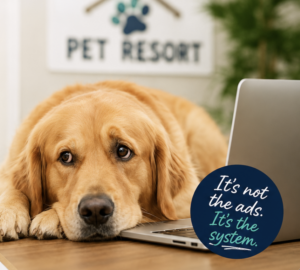
Most pet resort owners don’t have a marketing problem—they have a systems problem.
Ads, social media, email marketing, websites, and operations all play a role in generating bookings. When those pieces work independently, growth feels inconsistent. When they work together, marketing becomes predictable.
The most successful pet resorts don’t win because they spend the most on advertising. They win because they’ve built a system that consistently turns attention into trust, trust into inquiries, and inquiries into loyal clients.
That’s the difference between running marketing campaigns and building a growth engine.
