What Google AI Overviews Reveal About the Future of Search (and Why It Matters for Pet Resorts)
Search Behavior Has Evolved, and Google Is Responding
Google Search has quietly crossed an important threshold. While traditional keyword-based searches like “dog boarding near me” remain common, we’re seeing a steady increase in longer, natural-language queries that reflect real situations, concerns, and decision-making contexts.
Google’s response to this shift is the AI Overview—and it fundamentally changes how trust and visibility are established for pet resorts.
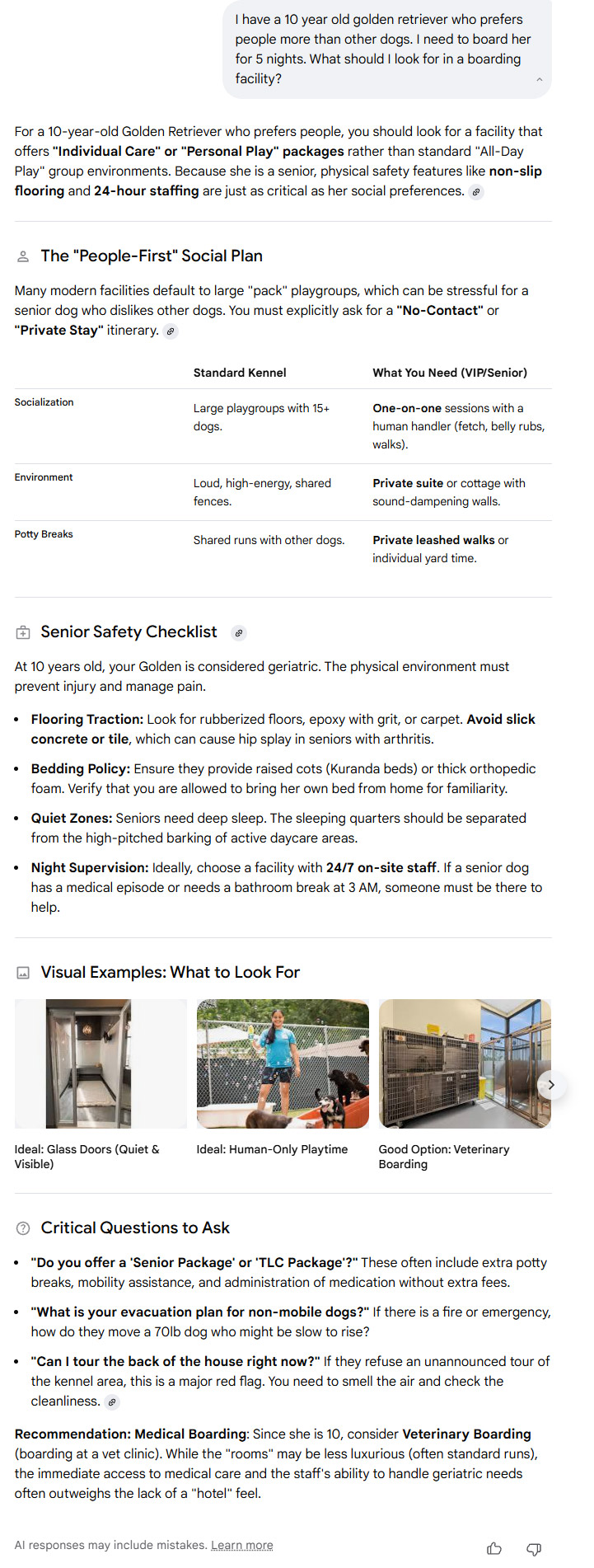
Example Google AI Overview
Use the scrollbar to view the whole image
Search behavior itself has evolved. We’ve analyzed review sentiment from thousands of pet resort customers across the country. When you look at those reviews in aggregate, clear themes emerge, including senior pet care, temperament, supervision, and trust.
The search query used below reflects those real-world concerns. It’s the kind of natural, conversational language question that increasingly mirrors how pet parents think, speak, and search online when making high-stakes pet care decisions.
For many of these queries, Google no longer starts by showing websites. It starts by answering the question directly, using AI Overviews powered by Google’s Gemini 3 model. These summaries are increasingly the first thing users see.
A Real Google AI Overview, Not a Hypothetical
The search query used here was specific, conversational, and realistic:
Instead of returning a traditional list of links, Google produced a detailed AI Overview that included:
- A recommendation tailored to a senior dog
- Structured sections explaining care options
- A comparison table
- A senior safety checklist
- Visual examples of environments
- Suggested questions a pet owner should ask
This is not a preview or an experiment. This is live Google Search behavior today.
What Google Is Actually Doing Here
This result is not a single website being featured.
Google’s AI is synthesizing information from multiple sources across the web, identifying consistent patterns, and assembling a response that it believes is helpful, accurate, and trustworthy.
In effect, Google is no longer just ranking pages. It is curating and presenting knowledge.
The AI Overview reflects what Google believes a responsible, well-informed answer should look like for a real person making a real decision.
Where the Content Comes From (and Why That Matters)
A common misconception is that Google’s AI is inventing this information. It is not.
AI Overviews are grounded in existing content that Google already understands and trusts. In this example, the synthesized response is built from patterns across content such as:
- Authoritative pet resort website service pages that explain real-world scenarios
- Long-form educational articles
- Frequently asked questions that reflect genuine customer concerns
- Visual content that reinforces written guidance
If your content does not clearly explain how your services work, who they are for, and what problems they solve, it cannot meaningfully influence AI-driven results like this.
EEAT in Practice, Not Theory
This is where Google’s EEAT Content Quality Framework comes into play in a very practical way.
In the AI Overview example above:
- Experience shows up in situational, practical advice
- Expertise shows up in safety considerations and care nuance
- Authoritativeness comes from consistency across trusted sources
- Trustworthiness is reinforced by clarity, structure, and tone
Notice what is absent. There is no promotional language, no exaggerated claims, and no keyword stuffing.
The AI Overview mirrors what Google believes trustworthy content should look like, not what markets the hardest.
Why Visual Content Now Matters More Than Ever
Another important shift is the inclusion of visuals inside AI Overviews.
In this example, Google includes images intended to reinforce ideas like quiet environments, human interaction, and appropriate care settings. These visuals are meant to support the written guidance rather than simply decorate the result.
At the same time, Google’s not getting this part right—the results reveal a current limitation.
While the images suggest calm spaces and supervision, they do not clearly demonstrate what senior pet care looks like in practice. Photos of empty enclosures, generic kennel spaces, or dogs alone do little to communicate attentiveness, training, or individualized care.
For pet resorts, this distinction matters and represents an opportunity. Visuals can show pet parents what thoughtful, hands-on care actually looks like and help reinforce trust at the moment decisions are being made.
Photos without context do not provide value. Visuals that support AI-driven results should demonstrate care in action, especially for senior pets. Images of trained staff assisting with mobility, offering calm one-on-one interaction, or supervising rest and routine convey attentiveness and experience far more clearly than photos of dogs alone or empty enclosures.
Visual content is no longer just about aesthetics. It plays an increasingly important role in how trust, care quality, and real-world competence are evaluated.
What This Means for Pet Resorts and Service Businesses
The central question has changed. It is no longer simply: “How do we rank for dog boarding near me?”
It is now: “Would Google trust our website to help explain this decision to a pet owner?”
Businesses that provide clear, experience-based explanations are more likely to influence AI-driven answers, even when users do not click directly through to their site.
This is not about chasing AI features. It is about becoming a reliable source of understanding in your category.
The New Visibility Test for Pet Resorts
Google AI Overviews are not replacing websites. They are filtering them.
The businesses that benefit are not always the loudest or the most keyword-optimized. They are the ones whose content helps Google confidently answer real questions.
- Visibility now depends on whether your content can inform AI-driven answers.
- Clarity determines whether Google understands what you offer and who it’s for.
- Trust is built through consistency, specificity, and real-world relevance.
For pet resorts, that means clearly explaining care models, environments, staffing, and safety in a way that reflects real-world experience. If your content can do that, it has a role in the future of search. If it cannot, it risks being invisible at the exact moment pet owners are making decisions.
Ready to Understand What This Means for Your Business?
The digital marketing landscape for pet resorts has fundamentally changed. Let’s discuss how these shifts impact your specific market and what strategic adjustments can strengthen your visibility and credibility.
